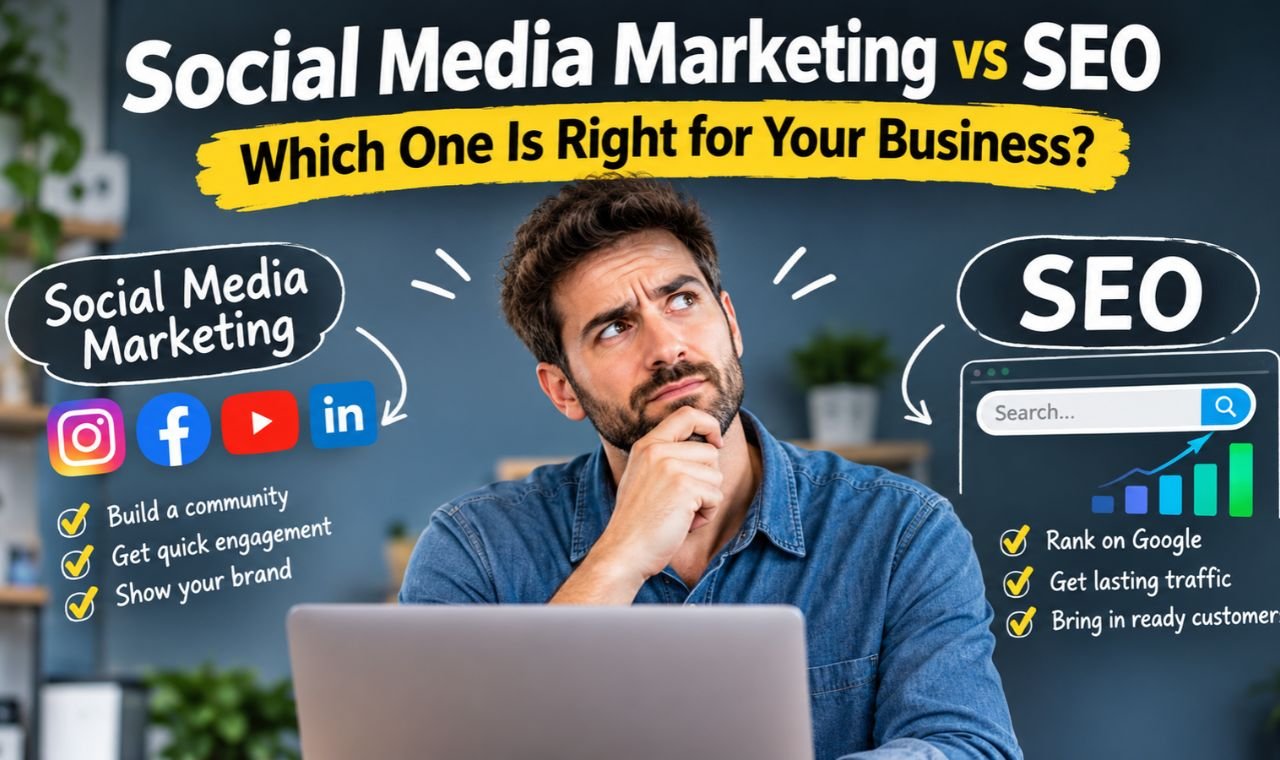
Picture a plumber, a landscaping crew, or a candle shop owner. They have a website, a Facebook page, and an Instagram account. They post a few times a week, and enquiries come in unevenly. A friend says SEO is the answer. An agency email says customers live on social media. Now the owner is stuck on the social media marketing vs seo question with a small budget and no clear way to decide.
Here’s the short answer. For your first leads, paid social media is usually faster, because an ad can reach people within days. SEO usually brings more motivated enquiries, but it takes months to build. Organic social media often takes the longest to turn into real enquiries. People type “seo or social media marketing which is better” into Google because they want a winner, but the honest answer depends on whether customers already search for what you sell, how much you can spend, and how well your website converts visitors.
SEO stands for search engine optimization. It’s the work of helping your website show up when people search Google for something you sell. Google crawls pages, stores them in an index, and ranks them when someone types a query. Visitors from those unpaid results are organic search traffic.
The work covers a few areas:
Think about a homeowner whose basement is flooding. She searches, taps one of the first results, and calls. That visitor already has the problem, which is why SEO enquiries tend to be warm. If you want help with the technical and local parts, SK Web Designing Solutions lists its SEO services on its site.
Social media marketing means using platforms like Facebook, Instagram, LinkedIn, and YouTube to put your business in front of people. Organic social media is the free content you post and the conversations in comments and direct messages. Paid social media advertising means paying the platform to show your content to a chosen audience.
Most people on these platforms weren’t looking for you. They were watching videos or checking on friends, so social media works by catching attention. If you want a team to run campaigns, SK Web Designing Solutions offers social media marketing services across the major platforms.
A practical example: a bakery posts a video of a custom cake being decorated. A few people send a direct message about a birthday order, and the owner runs a small ad for the same video aimed at people nearby. Notice how many steps sit between a view and a paid order.
Most social media marketing vs seo comparisons stop at definitions. Here are the differences between SEO and social marketing side by side.
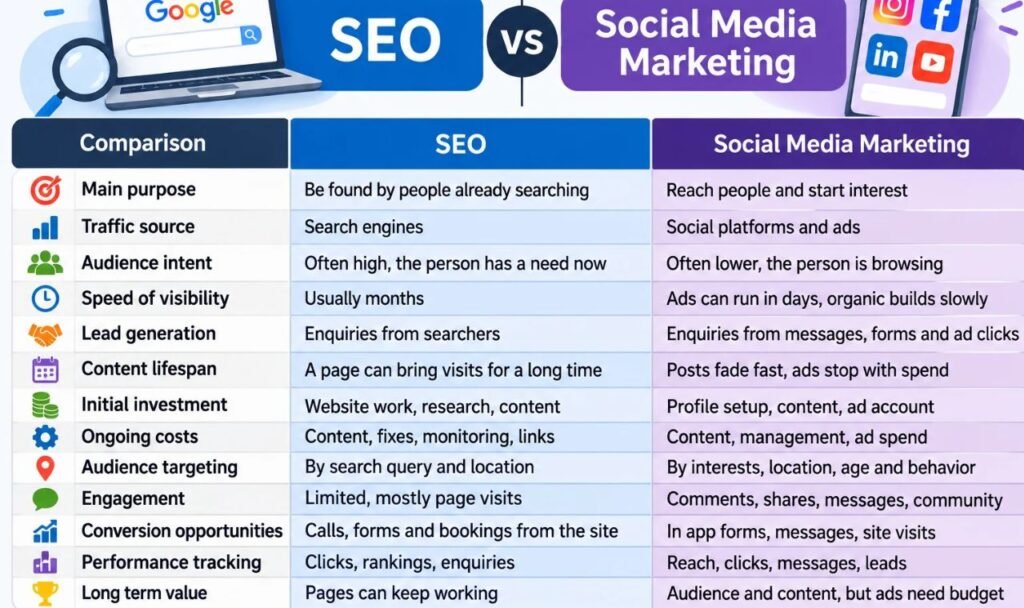
The biggest gap is intent. A searcher is usually looking for a solution, while a social media user is usually looking at something else. The two channels do different jobs.
Start by separating five things people often lump together:
Social media is very good at steps one and two, serving as a powerful promotional channel within the 4 Ps of marketing to drive brand visibility and initial engagement. SEO is better at moving people toward steps four and five because the searcher arrives with a need. Plenty of businesses celebrate likes while the cash register stays quiet.
Honestly, that’s the most common trap in the social media marketing vs seo debate. Paid social is the fastest route to a first enquiry. You set a budget, pick an audience, and launch. Meta describes a learning period after you launch or change an ad set, and delivery is less stable during it, so the first week or two is often testing.
Organic social takes longer, because you need an audience before posts reach anyone. SEO moves slowest at the start. Google has to find your pages, and they then need to earn rankings. In a video for site owners, Google’s Maile Ohye said to give an SEO company or consultant roughly four months to a year to show results. Nobody can promise an exact timeline.
Now, a hypothetical, not a real client,
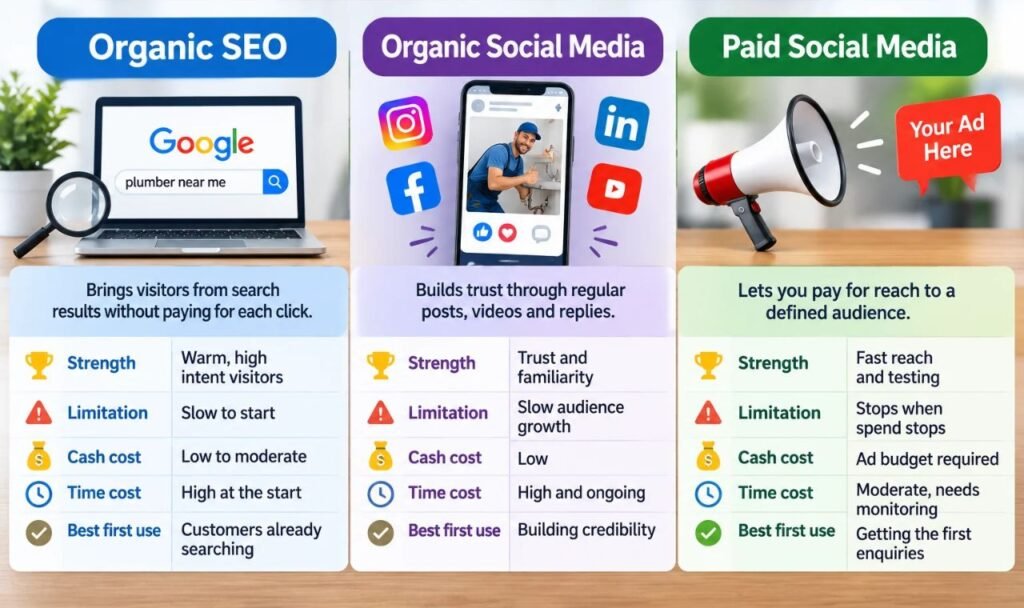
The social media marketing vs seo question really has three channels inside it, not two.
Organic SEO brings visitors from search results without paying for each click. You pay in time, content, and website work instead.
Organic social media means regular posts, videos, and replies. It costs little cash but a lot of consistency, and it builds trust because people can see your work.
Paid social lets you pay for reach to a defined audience. You manage budgets, test ads, and watch what happens after the click. Clicks are not enquiries, and that’s the part beginners miss. Meta’s own lead ads documentation says lead ads favor the number of leads by default, and that a form can add a review and confirmation step for higher-intent leads.
Plumbers, electricians, landscaping crews, and roofers usually win from local search because people search when something breaks. Service pages, a strong Google Business Profile, and honest reviews matter most. Social media shows finished jobs and builds trust.
Shoppers search for products they know and discover products they don’t. SEO helps with the first group through category and product pages. Social media helps with the second through video and short demos.
B2B buyers research for a long time, often with several people involved. They search for answers, then check a company on LinkedIn.
A new business has no reputation, so social media can introduce it quickly. SEO should still start early, because search visibility needs time to build.
SEO costs include keyword research, content writing, website improvements, technical fixes, link building, and monitoring. Social media costs include content creation, graphic design, video production, management, community replies, and ad spend.
When you hire an agency, you pay for people’s time. When you run ads, you also pay the platform for impressions or clicks, and that bill is separate from any agency fee. If you stop paying for ads, the traffic stops. A well-built SEO page can keep bringing visits after the work is done, though it still needs updates.
I won’t quote average prices, because they swing widely. Ask any provider for a written breakdown of what’s included. Google’s guidance on hiring an SEO also notes that a small local business can probably do much of the work itself, which matters if your budget is thin.
Numbers only help when they connect to enquiries.
For SEO: organic clicks, search impressions, keyword rankings, organic enquiries, conversion rate, and qualified leads.
For social media: reach, engagement, link clicks, direct messages, lead form submissions, and sales or conversions.
Track the point where a person becomes a lead, then calculate cost per lead:
Cost per lead = Total marketing spend ÷ Number of leads generated
Say you spend 600 dollars on a month of ads and get 12 enquiries. Your cost per lead is 50 dollars. That’s only an example. HubSpot’s guide to cost per lead explains how it differs from cost per acquisition, which covers turning a prospect into a customer. Also define “qualified” for your business, such as a homeowner in your service area asking for a quote.
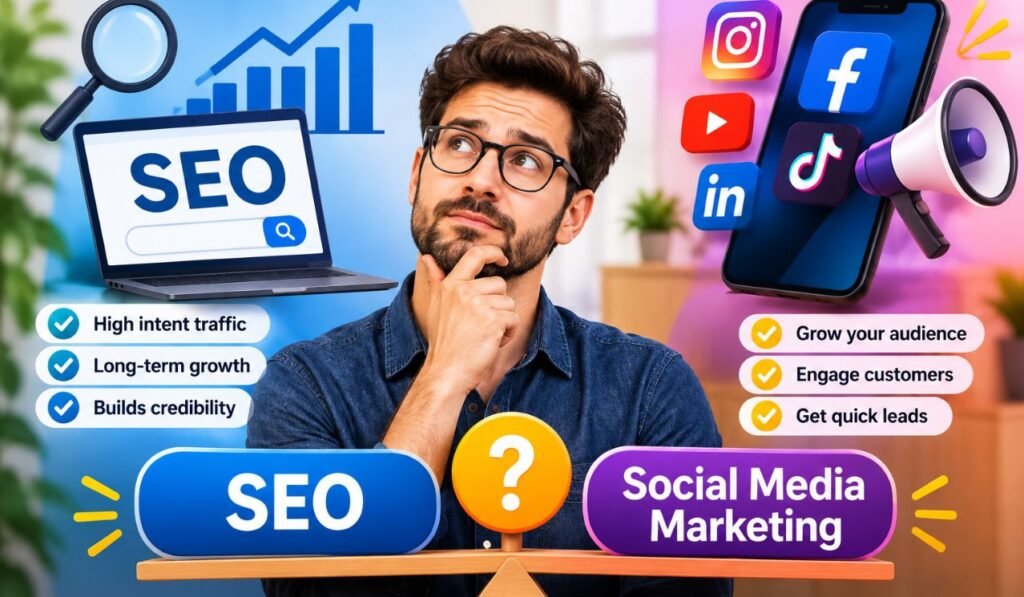
The social media marketing vs seo framing hides something useful. The two channels cover different moments in the customer buying journey.
Here’s an example. A landscaping company notices people keep asking on Instagram how much a patio costs. It writes a plain language page on what affects the price, shares it on social media, and uses it for local search.
A 90 day plan lets you test the social media marketing vs seo question with real numbers. It’s a starting plan, not a promise of rankings or sales.
Check that your website loads fast, works on phones, and shows your phone number clearly. Set up analytics, do basic keyword research, and complete your social profiles and Google Business Profile.
Improve your main service pages and publish one or two useful articles. Post consistently on the platforms your customers use. If cash flow allows, run a small paid campaign with one clear offer.
Look at real enquiries, not just traffic. Which channel brought calls or forms, and at what cost per lead? Keep what works and cut what doesn’t.
Settling social media marketing vs seo comes down to five questions:
In plain terms, a local service company with a good website should start with local SEO and add paid social for speed. A new product brand can start with social media and add SEO as it grows. A B2B company should pair search content with LinkedIn.
Common mistakes include judging social media by followers, expecting SEO to work in a month, and splitting a tiny budget across five platforms. There’s no universal budget split, so move money toward whatever produces qualified enquiries.
SK Web Designing Solutions is a marketing agency offering SEO services, social media marketing, website design, and website development. Its SEO work covers keyword research, technical SEO, local SEO, link building, and Google Analytics setup, with monthly reports.
Its social media services cover Facebook, Instagram, LinkedIn, and Twitter, including paid media and community management. The same team can improve your website, so your marketing sends people to pages that are ready. The company says it serves businesses across the United States and offers a free consultation. Contact SK Web Designing Solutions to discuss your digital marketing requirements.
In the social media marketing vs seo choice, each channel does a different job. Paid social can bring a first enquiry quickly, SEO builds search visibility that keeps working, and organic social builds trust. The right investment depends on your customers, budget, website, and goals.
Start with the channel your customers actually use, track enquiries and cost per lead, then add the second channel when you’re ready. SK Web Designing Solutions can help you plan the mix, so reach out to talk it through.
Neither wins for every business. SEO suits businesses whose customers search for their services, and social media suits businesses that need to introduce themselves.
Paid social media can produce enquiries faster, because ads can run within days. SEO usually takes months. Faster doesn’t always mean better quality, so compare cost per lead.
Yes, especially a local service business where customers search before they call. Social media can build trust but isn’t required.
There’s no fixed number. Set a budget you can sustain for several months, track enquiries, and shift spending toward qualified leads.
Yes. It offers SEO services and social media marketing, along with website design and development. You can contact the team to discuss which mix fits your business.

This article is written by the team at SKWebDesigningSolutions, a Florida-based marketing agency founded in 2016, specializing in web development, branding, SEO, and PR, helping businesses in Orlando and beyond launch, grow, and succeed online. Read More...
