Most business owners have heard of the 4 Ps of marketing, yet few use them as a working tool. The framework often stays in a textbook instead of shaping real decisions about what to sell, what to charge, where to sell it, and how to tell people about it. This guide changes that. You will learn what each P means, see how seven recognizable brands apply the 4 Ps of marketing, spot where each P commonly breaks down, and finish with a workshop you can run with your own team.
The 4 Ps of marketing are product, price, place, and promotion. Together they form the marketing mix, a marketing framework that helps a business decide how to bring an offer to a customer. The idea is generally credited to E. Jerome McCarthy in the 1960s, and the American Marketing Association offers a helpful overview of the four Ps of marketing.
Think of the four elements as dials on one control panel. Turn one without checking the others, and the whole system drifts.
The 4 Ps of marketing force clear answers to questions that otherwise stay vague. Who is this for? Why is it worth the price? Where do those people already shop? What will make them notice us?
A marketing mix strategy also keeps your team aligned. Designers, salespeople, and advertisers all work from the same picture of the target audience. HubSpot also covers the 4 Ps of marketing if you want a second explanation of the basics.
Your product is the full offer, including features, quality, packaging, service, and the problem it solves. Strong product development starts with market research and customer behavior, not with what the team likes. Ask what job the customer hires your product to do, then ask why they would pick yours over another. That answer is your product differentiation.
Price signals quality and must cover your costs, but it should also reflect what customers value. Common approaches include competitive pricing, cost plus pricing, and value based pricing. Harvard Business Review explains why companies should charge what their products are worth rather than simply react to rivals. Your pricing strategy should match your positioning. A premium promise with a bargain price confuses buyers.
Place covers distribution channels, from physical stores and marketplaces to your own website and apps. For e-commerce marketing, it also means site speed, easy checkout, and clear delivery terms. The best channel is the one your customers already use, not the one that is cheapest for you.
Promotion is your promotional strategy, including digital advertising, content, public relations, email, events, and social media. Its job is brand awareness first, then consideration, then action. Search visibility matters here, and a local SEO partner in Orlando is one example of how businesses make sure nearby customers can find them.
Social platforms matter too, and a focused Twitter marketing plan can support timely conversations and customer service.
Each example below shows how a well known company uses the 4 Ps of marketing, what makes the approach work, and what risk any business in that position should watch. The risks are strategic cautions, not claims about past failures.
Nike sells performance footwear and apparel built on innovation and athlete credibility. Prices sit at the premium end, supported by a brand story. Place combines wholesale partners, its own stores, and apps such as SNKRS. Promotion centers on athlete endorsements and the “Just Do It” message.
Why it works: Every P tells the same story of performance and aspiration.
Risk to watch: Premium prices and growing direct channels can strain retail partners and price-sensitive shoppers.
Lesson: Build a brand story strong enough to justify your price.
Netflix offers a library of original and licensed titles plus a recommendation experience. Pricing uses subscription tiers, including an ad supported plan introduced in late 2022. Place is the app on connected devices across more than 190 countries. Promotion relies on trailers, event releases, and social conversation.
Why it works: Tiered pricing lets different customers enter at different budgets.
Risk to watch: Subscription fatigue means price increases need to be matched by visible value.
Lesson: Offer more than one price door into your product.
IKEA designs affordable, modular furniture made for flat packing. It sets a low target price first and then designs the product to meet it. Place is a large showroom store arranged for browsing, supported by online ordering. Promotion has long relied on inspiring room displays and its famous catalogue.
Why it works: Product and price are planned together, so low cost never feels accidental.
Risk to watch: Self assembly and big stores depend on customers accepting extra effort and travel.
Lesson: Start with the price your customer can afford, then design backward.
Coca-Cola sells a consistent beverage portfolio. Pricing varies by pack size and market. Its place strategy is remarkable reach through bottling partners, retailers, restaurants, and vending. Promotion includes steady branding and campaigns such as “Share a Coke,” which printed names on bottles.
Why it works: Availability and recognition feed each other. People buy what they see everywhere.
Risk to watch: Shifting health preferences can reduce demand for core products, so the portfolio must keep evolving.
Lesson: Make your product easy to find and instantly recognizable.
Spotify delivers music and podcasts with personalized features such as Discover Weekly. Its pricing strategy pairs a free, ad-supported tier with paid premium. Place covers phones, computers, speakers, and cars. Promotion includes the yearly Wrapped recap, which customers share for free.
Why it works: The free tier is a promotion tool with a clear path to upgrade.
Risk to watch: The model depends on enough free users becoming paying ones while licensing costs stay manageable.
Lesson: Free offers work only when the upgrade reason is obvious.
McDonald’s offers a consistent core menu with local variations. Pricing leans on value menus and app deals. Place includes franchised restaurants, drive thru lanes, delivery, and mobile ordering. Promotion has used the “I’m Lovin’ It” message since 2003.
Why it works: Consistency lets customers know what to expect in any location.
Risk to watch: Heavy discounting can teach shoppers to wait for deals and squeeze franchise margins.
Lesson: Repeatable systems help a brand scale without confusing customers.
LEGO sells building sets across original and licensed themes, and its LEGO Ideas platform lets fans propose new designs. Pricing is premium and tied to quality. Place spans retailers, LEGO stores, and online sales. Promotion draws on films, community, and social content.
Why it works: Customers help shape the product, which deepens loyalty.
Risk to watch: Premium pricing can limit reach among budget conscious families.
Lesson: Involve your customers in product development.
Even strong businesses slip. Here are the mistakes we see most often and the fix for each.
| Element | Common mistake | Practical fix |
| Product | Building features nobody asked for | Validate with customer interviews and market research |
| Product | Weak product differentiation | State one clear reason to choose you over rivals |
| Price | Copying competitors without knowing costs | Calculate margins, then test value based pricing |
| Price | Discounting too often | Use limited, planned offers tied to a goal |
| Place | Selling where customers do not shop | Study how your audience buys and meet them there |
| Place | Slow, confusing online checkout | Simplify steps and show delivery details early |
| Promotion | Inconsistent brand messaging | Create a message guide for every channel |
| Promotion | Spreading budget across too many channels | Master two channels before adding a third |
A short marketing workshop turns theory into decisions. Gather three to six people from sales, service, and leadership, and set aside 45 to 60 minutes.
Repeat this exercise every quarter.
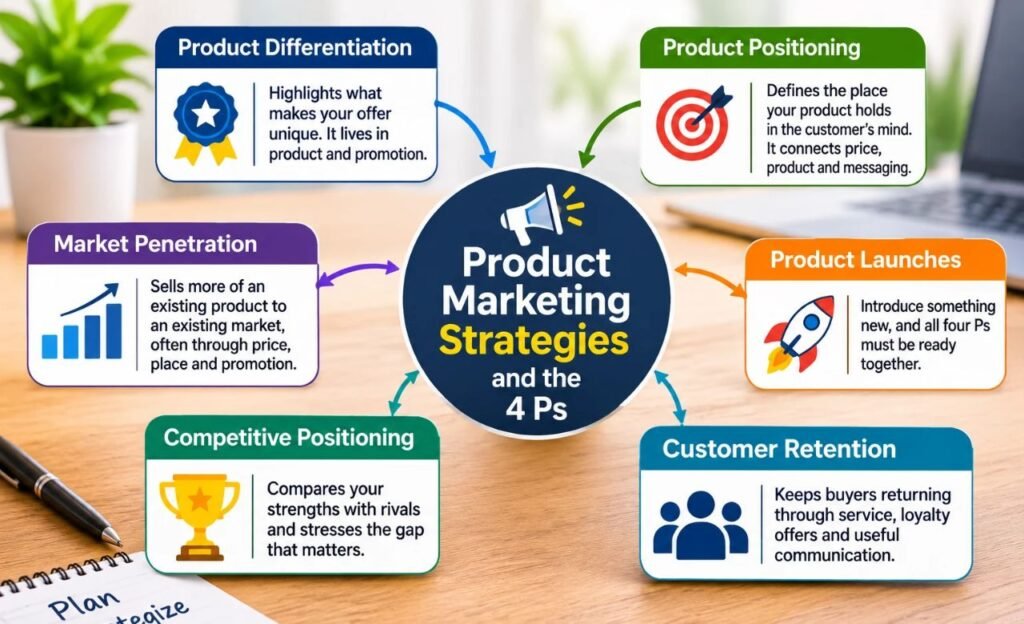
The main types of product marketing strategy each lean on different Ps:
A slogan in marketing is a short phrase that sums up your brand promise. It supports brand messaging, helps customers recognize you, reinforces positioning, and gives promotional campaigns a consistent thread. “Just Do It” and “I’m Lovin’ It” show how a short line can last for years when it matches the brand. A slogan works best alongside a strong visual identity, which is why many businesses pair it with professional logo design.
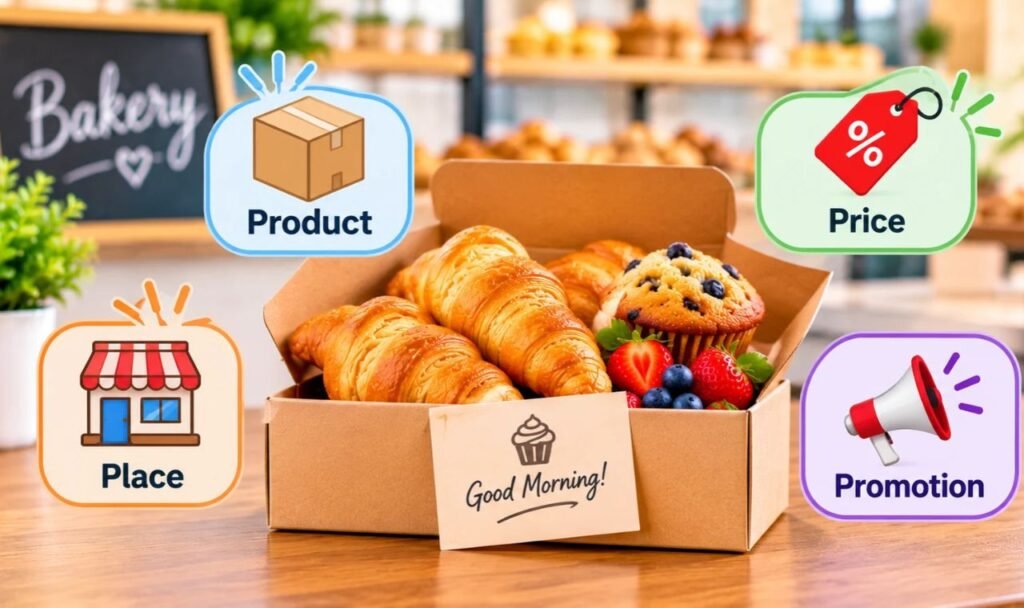
Imagine a local bakery that wants more weekday sales. Its product becomes a boxed office breakfast platter made with fresh ingredients. Its price is set per person with a small discount for recurring orders. Its place includes a simple online order form and delivery within five miles. Its promotion uses local search listings, social posts with photos, and a short slogan on every box. Each P supports the others, so the offer is easy to understand and easy to buy.
Marketing KPIs show whether your mix is working. Track a few for each P and review marketing performance monthly.
| Element | Useful KPIs |
| Product | Customer satisfaction score, repeat purchase rate, return rate |
| Price | Gross margin, conversion rate at each price, average order value |
| Place | Sales by channel, cart abandonment rate, delivery time |
| Promotion | Website traffic, cost per lead, return on ad spend, brand awareness |
SK Web Designing Solutions helps businesses turn a marketing mix strategy into a working online presence. Its team covers website design and development, SEO, PPC, social media marketing, logo design, and ecommerce services. A well built website supports place, search, and paid campaigns, increases visibility, and a clear logo strengthens brand identity. Together, these services help businesses reach their target audience and improve customer acquisition at a steady pace.
The 4 Ps of marketing work best when treated as one system. A strong product, a fair price, the right channels, and a clear message should all point toward the same customer.
Start small. Run the workshop, choose three measurable actions and review the results next quarter. Small, consistent improvements across each P will do more for your growth than any single big campaign.
They are product, price, place, and promotion. This marketing framework helps businesses decide what to offer, what to charge, where to sell, and how to reach customers.
Netflix offers a streaming library (product), subscription tiers (price), apps on many devices (place), and trailers with social buzz (promotion).
Start with your target audience, then define each P to match their needs. Check that all four support one message, then set KPIs and review them regularly.
The 7 Ps add people, process, and physical evidence to the original four. They suit service businesses where the customer experience matters as much as the offer.
SK Web Designing Solutions offers website development, SEO, PPC, social media marketing, logo design, and ecommerce support. These services improve visibility, strengthen brand identity, and help attract customers.

This article is written by the team at SKWebDesigningSolutions, a Florida-based marketing agency founded in 2016, specializing in web development, branding, SEO, and PR, helping businesses in Orlando and beyond launch, grow, and succeed online. Read More...
