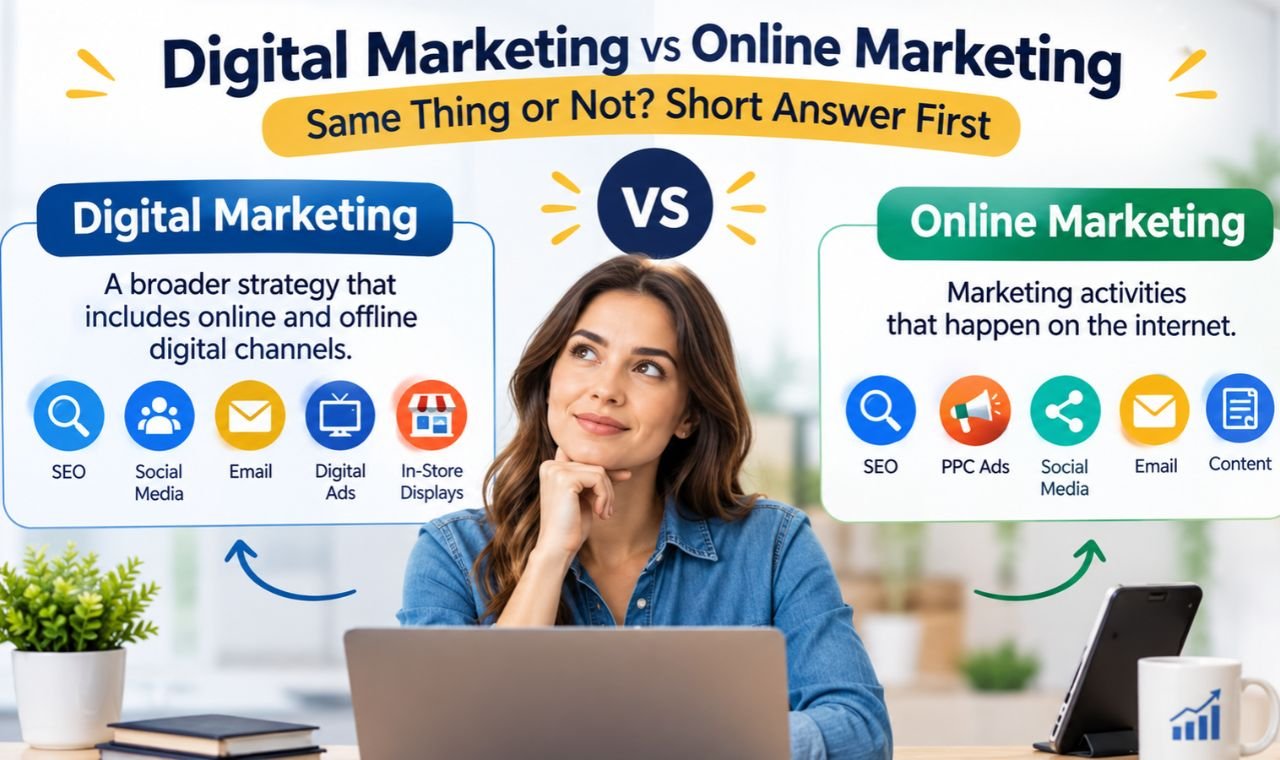
Digital marketing and online marketing are closely related, but they aren’t exactly the same. Online marketing is a part of digital marketing because it uses internet connected channels. Digital marketing has a broader scope that also includes offline digital activities, such as SMS promotions and digital billboards. However, many businesses and marketing professionals use both terms interchangeably.
Understanding the difference can help business owners choose suitable promotional channels, manage their budgets, and reach potential customers more effectively. Let’s look at how these approaches work and when businesses should use them.
The main difference is the technology used to reach an audience.
Digital marketing covers promotional activities that use digital devices and technologies, whether or not they require an internet connection. Online marketing specifically focuses on internet based activities.
For example, a company promoting its services through Google Ads is using online marketing. A retailer displaying advertisements on electronic screens inside its store is using digital marketing, but that activity doesn’t necessarily qualify as online marketing.
According to Salesforce’s explanation of digital marketing, digital marketing covers a broad range of promotional activities, including online channels.
| Comparison factor | Digital marketing | Online marketing |
| Scope | Online and offline digital activities | Internet based activities |
| Technology | Digital devices and platforms | Internet connected platforms |
| Examples | SMS, digital displays, websites, email | SEO, PPC, social media, email |
| Internet required | Not always | Yes |
| Audience reach | Online and physical environments | Internet users |
| Measurement | Depends on the channel | Often includes detailed online analytics |
| Main purpose | Promote through digital technology | Reach customers through the internet |
The simplest way to remember the difference is that online marketing is one part of digital marketing. Every online marketing activity uses digital technology, but not every digital marketing activity requires an internet connection.
People researching internet marketing vs digital marketing often find that the terms describe similar activities. Internet marketing focuses on online channels, while digital marketing also includes offline digital tools.
Since most businesses rely on websites, social media, email, and online ads, the terms are often used interchangeably.
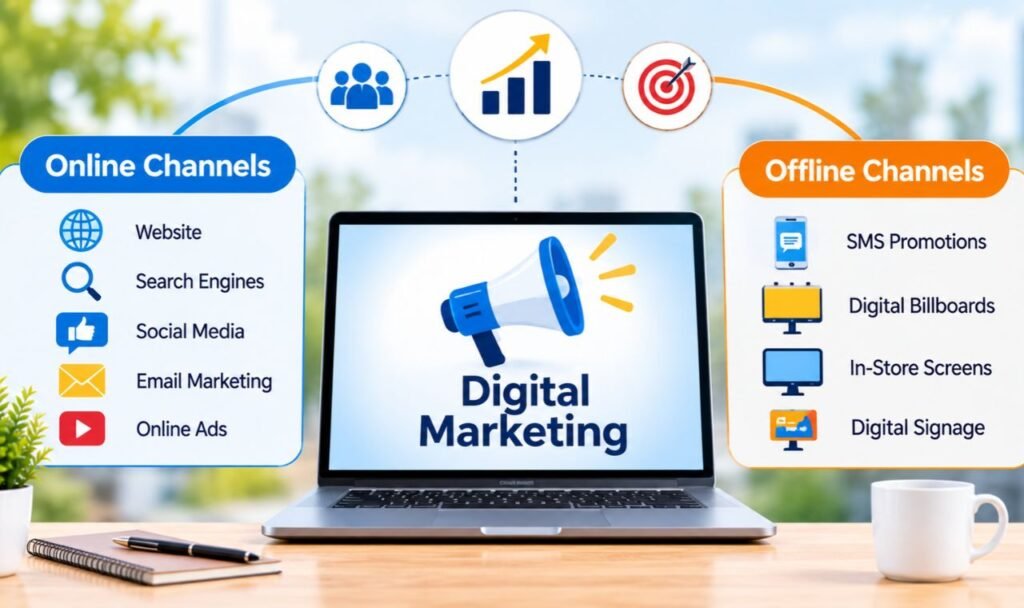
Digital marketing refers to promoting products, services, or brands through electronic devices and digital communication technologies.
In simple words, what is the definition of digital marketing? It is any marketing activity that uses digital technology to communicate with potential or existing customers.
Businesses use it to build brand awareness, introduce products, generate leads, encourage purchases, and maintain customer relationships.
The American Marketing Association’s explanation of digital marketing provides additional context about the role of digital technologies in marketing activities.
Digital marketing begins with a business goal and an understanding of its target audience.
A company might want more website enquiries, increased product sales, or better customer retention. It then selects appropriate channels to reach people who may be interested in its offerings, often weighing options like social media marketing vs SEO to decide which approach fits its timeline and budget best.
For example, a local home improvement company might:
Each activity supports the company’s marketing strategy, but the channels work differently.
Digital marketing includes two broad categories.
Online digital marketing uses internet connected channels, including
Offline digital marketing uses digital technology without necessarily requiring an internet connection during the promotional activity.
Examples include:
SMS is commonly classified as mobile or digital marketing, although it does not always depend on an internet connection. Similarly, digital billboards can display advertisements without requiring an internet connection at the moment someone views them.
This broader definition explains why digital marketing isn’t limited to websites and social media.
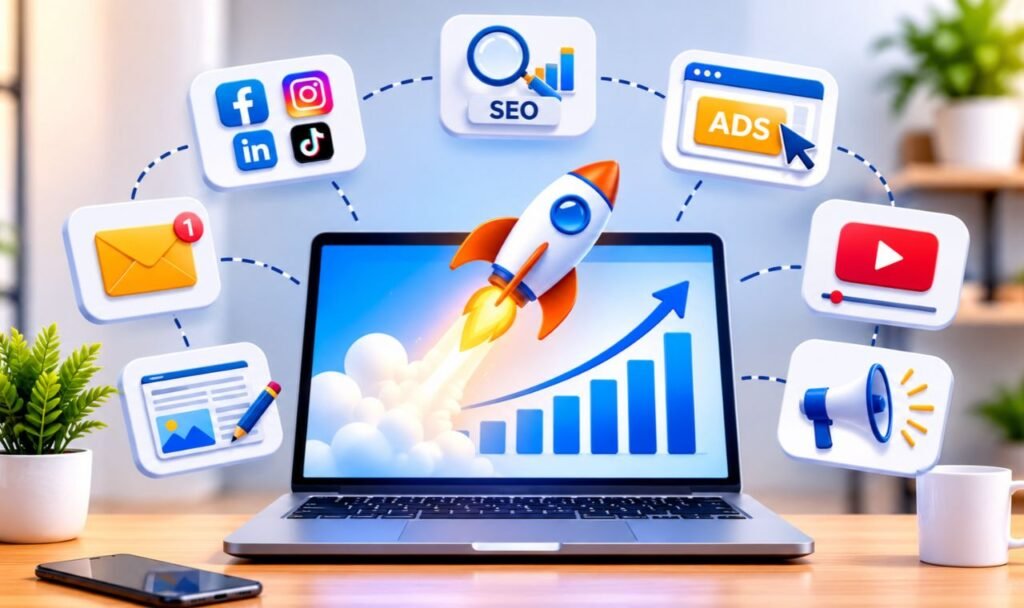
Online marketing refers to promotional activities carried out through the internet to attract, communicate with, and convert potential customers. It’s also commonly called internet marketing.
If you’re wondering what is digital online marketing, it generally means promoting a business through websites, search engines, social media, email, and online ads.
When comparing internet marketing vs digital marketing, the key difference is that internet marketing requires an internet connection, while digital marketing also includes offline electronic promotional methods.
Here are some common online marketing channels.
Search engine optimization helps websites appear in relevant organic search results.
For example, someone searching for a web design company might discover a business through its blog articles, service pages, or local search listings.
SEO focuses on website structure, content quality, technical performance, and relevance to search queries.
Unlike paid advertisements, organic search visibility doesn’t require businesses to pay for every click. However, SEO requires ongoing work, and rankings aren’t guaranteed.
Businesses looking to improve their search visibility can explore professional SEO services as part of their marketing strategy.
Pay per click advertising is an online advertising model in which advertisers generally pay when someone clicks their advertisement.
Google Ads is a common example.
A plumbing company might create advertisements targeting people searching for plumbing repairs in its service area. Interested users can click the advertisement and visit a landing page to request an estimate.
PPC can provide visibility without waiting for organic rankings, but results depend on competition, targeting, advertising quality, landing page experience, and budget.
Social media marketing involves promoting businesses through platforms such as Facebook, Instagram, LinkedIn, and TikTok.
It includes organic and paid activities.
Organic marketing involves publishing posts, sharing videos, responding to comments, and building relationships with followers.
Paid campaigns allow businesses to promote content to selected audiences using available targeting options.
For example, a clothing retailer might share product photographs organically while running paid advertisements for a seasonal collection.
Both methods can support brand awareness, engagement, and lead generation.
Email marketing allows businesses to communicate directly with people who have subscribed or agreed to receive their messages.
Common examples include newsletters, promotional emails, product announcements, welcome messages, and customer updates.
A business can use email marketing to maintain relationships with existing customers instead of relying entirely on attracting new visitors.
The key is to send relevant messages at an appropriate frequency and respect subscriber preferences.
Content marketing involves creating useful information that attracts and educates a target audience.
Common formats include:
For instance, a website design company could publish an article explaining why a business website receives visitors but fails to generate enquiries.
Content marketing often works alongside SEO, email campaigns, and social media promotion.
Affiliate marketing involves partnering with individuals or businesses that promote products or services in exchange for an agreed commission or referral payment.
Influencer marketing involves collaborating with content creators who have established audiences.
For example, a fitness brand might work with a fitness creator to introduce a product to relevant followers.
Both methods can help businesses reach audiences beyond their existing customer base. Their effectiveness depends on audience relevance, credibility, and the quality of the promotion.
Although these approaches share many channels, understanding their differences makes it easier to select the right marketing strategy.
| Factor | Digital marketing | Online marketing |
| Marketing scope | Online and offline digital activities | Internet based promotions |
| Channels and platforms | Websites, SMS, digital displays, email | Search engines, websites, social media |
| Audience reach | Online and physical environments | Internet users |
| Targeting | Depends on the channel and available data | Often supports detailed audience targeting |
| Cost | Varies across digital channels | Can start small but become expensive |
| Measurement | Uses channel specific tracking | Often provides detailed online analytics |
| Flexibility | Depends on the technology used | Campaigns can often be adjusted quickly |
Digital marketing has a wider scope because it includes both online and offline digital promotional activities.
Online marketing focuses specifically on internet based communication.
For example, a company using a website and a digital billboard is participating in broader digital marketing. Its website promotion is also online marketing, while the billboard activity may not be.
Digital marketing can include electronic displays, SMS, websites, email, and mobile applications.
Online marketing concentrates on internet based platforms such as search engines, social networks, websites, and advertising networks.
Some channels overlap. Email, for instance, is generally both digital and online marketing.
Online marketing helps businesses reach audiences across different locations, depending on their products, services, and targeting.
Offline digital activities can reach people in particular physical environments.
For example, an advertisement on a shopping center screen may reach shoppers already visiting that location.
Online platforms often provide targeting options based on location, interests, search behavior, and previous interactions.
Digital marketing also supports personalization through customer databases, SMS lists, and other communication technologies.
However, a digital billboard generally cannot provide the same individual level of personalization as a targeted email campaign.
Online marketing can be an accessible starting point for smaller companies.
Businesses can publish social media content, create websites, and develop organic search visibility without committing to a large advertising budget.
However, competitive PPC campaigns, professional content production, and ongoing SEO can become expensive.
Other digital channels, such as large billboard placements, may also involve substantial production and advertising costs.
Businesses should compare the cost of reaching relevant audiences and generating valuable enquiries rather than assuming one category is always cheaper.
Online marketing often provides detailed campaign information.
Businesses can track website visits, advertisement clicks, search impressions, email engagement, and online conversions.
Other digital activities may require different measurement methods.
For example, a retailer might measure responses to an in store display through a unique promotional code or QR code.
Online advertisements, email campaigns, and social media posts can often be adjusted quickly.
Businesses can test different headlines, update landing pages, change audience settings, and modify advertising budgets.
Offline digital campaigns can also be flexible, although changes may depend on display providers, scheduling arrangements, and available technology.
The difference becomes easier to understand through everyday business examples.
Imagine a local web design company trying to attract new clients.
It uses SEO to appear in Google search results, Google Ads to reach potential customers, social media posts to share completed projects, and email campaigns to follow up with prospects.
All these activities are online marketing because they use internet connected channels.
They also fall under digital marketing because online marketing is part of that broader category.
Consider a clothing retailer with several physical stores.
The company sends promotional SMS messages about upcoming discounts and displays product advertisements on electronic screens inside its stores.
Both activities are examples of digital marketing. However, neither necessarily qualifies as online marketing because customers don’t need to visit an internet based platform to receive the promotion.
A home improvement company places an advertisement on a digital billboard with a QR code.
People who scan the code visit a landing page where they can explore services and submit enquiries.
This campaign combines both approaches:
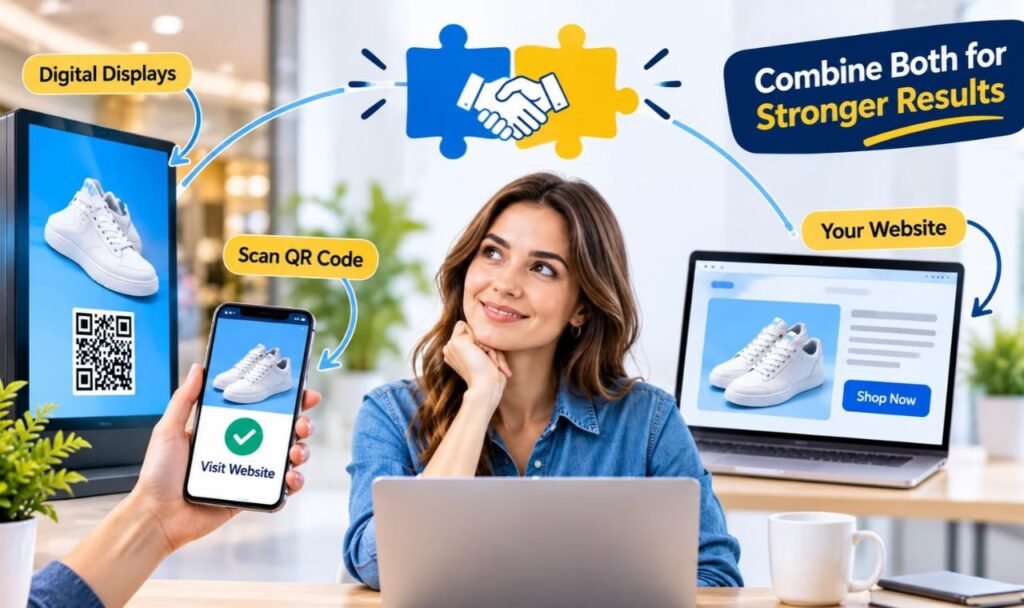
Yes. Businesses don’t need to choose only one approach. They can combine different channels to create a connected promotional strategy.
For example, a retailer could use digital screens inside its stores to advertise a seasonal offer. Customers could scan a QR code, visit the website, browse products, and place an order.
A service company could combine local advertising with SEO, social media, and dedicated landing pages.
Customers may discover a business through several channels before deciding to contact it.
Someone might see a digital billboard, visit the website later, and then find the company’s social media profile.
Keep important details consistent, including:
Businesses can connect offline promotions with online experiences through QR codes, dedicated landing pages, promotional codes, and tracked enquiry forms.
These methods make it easier to understand whether physical advertising is generating online responses.
A website can connect different marketing channels and provide one place for customers to learn about a business.
Visitors arriving from social media, paid advertisements, organic search, or QR codes should be able to find relevant information and understand what to do next.
Depending on the business, that action might involve requesting a quote, booking an appointment, making a purchase, or calling the company.
For additional context, see HubSpot’s guide to digital marketing.
There isn’t one answer for every company. The right choice depends on the audience, available budget, industry, and business objectives.
Online marketing is often a practical starting point.
Small businesses can create professional websites, publish useful content, improve organic search visibility, and maintain social media profiles.
Once these foundations are established, they can test paid advertising or additional digital channels.
Businesses such as plumbers, landscapers, electricians, and contractors often benefit from local SEO, paid search advertising, and social media.
These channels can help them reach people actively searching for nearby services.
Digital displays and local advertising placements may provide additional exposure when they suit the target audience.
E-commerce companies generally depend heavily on online marketing because customers browse products and complete purchases through websites or applications.
Useful channels include SEO, shopping advertisements, social media, email campaigns, and affiliate partnerships.
SMS promotions and digital displays at physical retail locations can also support an e-commerce brand.
Business to business companies often have longer sales cycles because customers may need several conversations before making a purchase.
SEO, educational content, LinkedIn campaigns, webinars, and email marketing can help attract decision-makers and maintain communication.
Digital advertising at industry events may also help larger companies reach relevant audiences.
Larger organizations often have the resources to combine online and offline digital channels.
A national retailer, for example, might use online advertising, email campaigns, mobile promotions, digital billboards, and electronic displays inside stores.
The challenge is coordinating these activities and evaluating their contribution to business results.
Running campaigns is only part of the process. Businesses also need to understand whether their activities produce meaningful results.
The right metrics depend on the campaign’s objectives.
Website traffic shows how many people visit a website, while organic search clicks measure visits from unpaid search results.
Businesses should examine where visitors come from, which pages they view, and whether they find relevant information.
A website receiving thousands of visitors without generating enquiries may need better targeting or improved landing pages.
Click through rate measures the percentage of people who click an advertisement or link after seeing it.
Conversion rate measures the percentage of visitors who complete a desired action, such as submitting a form, purchasing a product, or booking an appointment.
A low conversion rate may indicate that a landing page needs clearer messaging or a more noticeable call to action.
Cost per lead measures how much a business spends to generate a potential customer enquiry.
Customer acquisition cost measures the overall cost of acquiring a paying customer.
These figures help businesses determine whether their marketing spending is commercially sustainable.
A campaign generating many enquiries may still be inefficient if those leads rarely become customers.
Return on ad spend, or ROAS, measures revenue attributed to advertising relative to advertising expenditure.
For example, spending $500 on advertisements and generating $2,000 in attributed revenue produces a 4:1 ROAS.
This metric is useful, but it doesn’t account for every business expense or automatically represent profit.
Email engagement includes clicks, unsubscribes, and conversions. Open rates should be interpreted carefully because privacy features can affect their accuracy.
Social media engagement includes comments, shares, saves, and reactions.
These metrics help businesses understand whether their content attracts attention and encourages interaction.
Not every successful marketing activity produces an immediate website visit or sale.
Digital billboards, SMS promotions, and in store displays may contribute to brand recognition or encourage later purchases.
Businesses can measure responses through unique promotional codes, QR scans, dedicated landing pages, customer surveys, and tracked enquiry sources.
Don’t judge marketing performance by website traffic alone. A smaller number of relevant visitors who become paying customers can be more valuable than thousands of visitors who leave without taking action.
The difference between digital marketing and online marketing is mainly their scope. Online marketing focuses on internet based promotional activities, while digital marketing also includes electronic channels that don’t require an internet connection. Both approaches can help businesses build awareness, attract customers, and generate opportunities. Rather than choosing one over the other, consider your audience, objectives, and budget. A well planned strategy combines the channels that make sense for your business and measures their contribution to meaningful results.
Not exactly. Online marketing focuses on internet based activities, while digital marketing also includes offline digital channels such as SMS promotions and electronic displays. The terms are often used interchangeably.
Digital marketing means promoting products, services, or businesses through digital technology. It includes websites, search engines, social media, email, SMS, and digital advertising.
Yes. Internet marketing requires an internet connection to reach customers, while digital marketing covers a broader range of electronic promotional activities, including some that work offline.
Online marketing is often a practical starting point because small businesses can use SEO, social media, and targeted advertising to reach potential customers. Additional digital channels can be introduced as their needs grow.
SK Web Designing Solutions offers website design and development, SEO, social media marketing, PPC management, and website maintenance to help businesses strengthen their online presence.

This article is written by the team at SKWebDesigningSolutions, a Florida-based marketing agency founded in 2016, specializing in web development, branding, SEO, and PR, helping businesses in Orlando and beyond launch, grow, and succeed online. Read More...
