
Getting good traffic and rankings is improving, but no calls are the most common issue for business owners. However, you couldn’t get phone calls or inquiries coming in. This is the most taken-for-granted issue with small business websites.
It usually leads to confusion because everything seems to be working on the surface.
The reality is that traffic alone doesn’t mean success. Many websites suffer from no-lead issues even when SEO or ads are doing their job correctly. The real issue lies in how visitors experience the website after they arrive.
At our company, SKWebDesigningSolutions, we often see businesses struggling with this exact gap. The problem is rarely visibility; it’s conversion. That gap between a visitor landing on your page and actually contacting you is where most opportunities are lost.
Fixing these conversion leaks can often produce better results than spending more money on marketing. Rather than attracting another 1,000 visitors, improving your conversion rate allows you to generate more leads from the traffic you already have.
Getting traffic gives a sense of progress, but it can be misleading. A website can attract multiple visitors and still not gain calls from the site if those visitors do not have proper clarity or motivation to take action.
However, most of the time, visitors arrive with a specific intent, but if our website does not specifically confirm they are in the right place, they leave instantly. This is where conversion rate issues quietly start affecting performance and start increasing bounce rate.
Sometimes the message on the website is too generic, or the services are not explained in a way that connects with user intent. Other times, the value proposition is buried under unnecessary design elements or unclear navigation. The result is always the same people browse, but they don’t act.
As stated by HubSpot, improving site conversion rates is more profitable than frequently increasing traffic because converting existing visitors usually costs less than acquiring new ones.
That is to say:
With conversions, website traffic becomes nothing more than a vanity metric.
A conversion leak is any obstacle that stops visitors from taking action, such as calling, filling out a form, or making a purchase.
Common causes are unclear messaging, weak CTAs, poor customer experiences, and a lack of trusted signals. Despite small problems, they can lead to lost leads and wasted marketing efforts.
Many conversion problems go overlooked. Businesses pay attention to traffic instead of visitors’ behavior. Most of the owners track website traffic, Google rankings, ad performance, and social media metrics.
But they rarely ask:
According to the Contentsquare Digital Experience Benchmark Report, high bounce rates, short sessions, and abandoned forms often indicate hidden conversion problems, not a lack of traffic. The good news is that these issues can be identified and fixed.
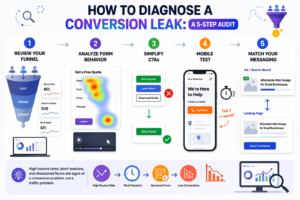
Alt Text: A five-step guide: “How to Diagnose a Conversion Leak.
Before fixing anything, find out where visitors actually drop off:
A strong Call-to-Action (CTA) tells visitors exactly what to do next. Generic buttons like “Submit” or “Learn More” often fail to encourage action. Instead, use clear, benefit-driven CTAs such as “Get Your Free Website Audit” or “Request a Free Consultation.”
Placement matters too. Display CTAs prominently throughout your page, not just at the bottom, so visitors can easily take the next step. Clear, visible CTAs reduce friction and help turn more visitors into leads.
HubSpot has published extensive A/B test data on CTA wording and placement across its own landing pages. Their consistent finding is that CTAs describing a specific benefit (a guide, an audit, a consultation) outperform generic action words, because visitors understand exactly what happens after the click.
The lesson: a CTA shouldn’t ask people to work; it should show them what they gain.
A great structured landing page can help to change your results. Which is why landing page optimization is so important for digital performance.
Websites that don’t convert often use landing pages like general info pages instead of focused conversion tools. A perfect landing page makes the value simple and clear right away, removes confusion, and guides users toward one specific action.
It answers the visitor’s main question upfront: why should I choose this business over others? When landing pages are set up properly, they stop sitting there like passive content and start working like real sales tools. This is often where a lead generation website starts to come together.
An effective landing page should answer these questions almost immediately:
It should clearly explain the offer, highlight its benefits, build trust with testimonials or case studies, and include a strong CTA.
Unbounce, which has analyzed data across billions of conversions from landing pages built on its platform, consistently finds that single-goal, distraction-free pages outperform multi-purpose ones largely because removing choices removes hesitation.
Cybersecurity company Flare simplified its “Book a Demo” landing page by removing competing CTAs and focusing on a single action. As a result, the company reported a 65% increase in conversions within one week, according to Averi.ai. This shows that generating traffic through SEO or paid ads is only part of the strategy. A clear, focused landing page can significantly improve conversion rates.
On the website, user feedback plays a more important role than most business entrepreneurs realize. Even if your messaging is powerful, even a poor design flow can create hesitation.
Most popular website UX issues include slow loading speed, cluttered layouts, and confusing user interface structures. When users have to think too much about where to click next, they usually don’t continue.
Mobile experience is more crucial nowadays, as many users visit your site, just doing so from their phones. And if the mobile version feels difficult to use, they leave immediately. This is one of the silent reasons behind weak engagement despite good traffic.
Good UX is not about complexity. It is about clarity, speed, and ease of movement between sections without confusion.
Research from Google Search Central shows that page speed and user experience affect both search rankings and conversion rate. Walmart reported a 2% increase in conversion for every one-second improvement in page load time, and on the other hand, Staples saw a 10% increase in conversions after reducing homepage load time by one second.
These examples show that a fast website not only improves SEO but also helps convert more visitors into customers.
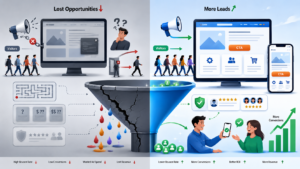
Alt Text: Split diagram comparing lost leads vs website conversions
Many small business website problems come from focusing too much on appearance rather than function. A visually attractive website may feel impressive, but if it doesn’t guide the user, it won’t generate leads.
Website visuals attract visitors, which may feel impressive, but if they do not tell the user the right way, they will not easily generate leads for your website.
A more common issue is a distinction between your marketing and your website. If ads promise that one thing but your landing page says something else, people notice it, and trust decreases immediately. Even small gaps. Like unclear service descriptions or no clear sense of pricing can make someone frustrated. And that hesitation is mostly enough to stop leads from reaching out.
A real lead generation website isn’t just a bunch of pages; it’s a system built to turn attention into action.
Every section has a job to do, and every page supports the same goal: getting inquiries.
Meanwhile, each part of the website should have a clear meaning. When creating, messaging, and user flow are aligned, the whole thing starts working better for itself.
A simple checklist for evaluating whether a website is currently set up to do this:
If a site gains enough traffic but still does not get calls, the main problem is rarely the quality of the traffic alone. But most of the time, the main problem lies in how the website handles that traffic once it arrives.
From conversion rate issues to low messaging, from poor landing page optimization to unresolved website UX issues, every small friction point adds up and affects performance.
Significantly, the basic CTA mistakes help you reduce inquiries. The goal isn’t to impress users or get as much as possible; it’s to help the right ones to take action. When your website is clear, focused, and easy to use, it starts working as a solid lead generation tool.
At SKWebDesigningSolutions, we help businesses spot these hidden gaps and turn underperforming websites into well-performing lead-generating systems that bring real results, not just traffic.


This article is written by the team at SKWebDesigningSolutions, a Florida-based marketing agency founded in 2016, specializing in web development, branding, SEO, and PR, helping businesses in Orlando and beyond launch, grow, and succeed online. Read More...
