
Most businesses start looking at website redesign services after a run of small frustrations. The site looks dated next to competitors. Pages crawl on a phone. Visitors can’t find your contact details, and the enquiries that do arrive are fewer than they should be.
Professional website redesign services generally cover an audit of your current site, new UI and UX design, responsive development, content restructuring, technical SEO with redirects, and testing before launch. The exact scope depends on your project agreement.
A redesign is more than a new look. Changing layouts, URLs, or content without a plan can erase years of search visibility. Good projects begin with business goals, protect what already works, and treat functionality and SEO as seriously as visuals. This guide covers what’s included, what drives the cost, and how to redesign without losing the rankings you’ve earned.
Website redesign services improve an existing site’s design, structure, performance, and functionality so it supports your business goals better. Unlike building from scratch, a redesign starts with a site that already has pages, backlinks, and search history. That history is an asset, and protecting it is part of the job.
Projects usually fall into three levels:
Done well, a redesign improves user experience, brand presentation, and functionality, and it gives visitors clearer routes to becoming leads.
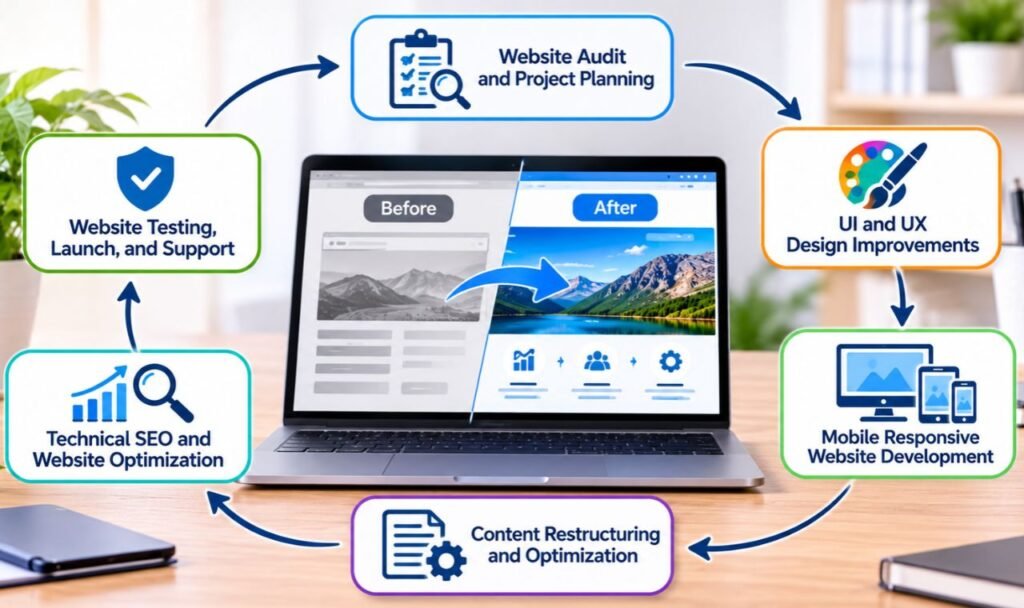
Packages for website redesign services differ between providers, so get deliverables in writing. A thorough project usually covers the following.
The team reviews the current site for technical problems like broken links, slow pages, and thin content, then pins down your goals. From there, they plan the new website architecture, including the sitemap and page templates. Skipping this stage is the most common reason redesigns go wrong.
This covers layout, navigation, visual hierarchy, readable text, calls to action, and user journeys. A visitor on a service page should quickly see what you offer, why you’re credible, and what to do next. Accessibility belongs here too. The W3C’s Web Content Accessibility Guidelines are a reliable reference for readable, inclusive, and easy-to-navigate pages.
Responsive web design adapts layouts to every screen size. Expect a usable mobile menu, text readable without zooming, buttons large enough to tap, and forms that work on a phone. A booking form that works on desktop but fails on mobile quietly costs you enquiries.
Existing content gets reviewed, improved, and reorganized around your core positioning often aligning service pages with the 4 Ps of marketing so your product, pricing, placement, and promotion come across clearly. Pages that perform stay, weak ones are rewritten, duplicates are merged, and outdated services are updated.
This covers metadata, heading structure, URL preservation, redirects, image optimization, crawlability, indexability, and speed. It should be planned before development begins, because URL and template decisions are expensive to reverse later. Many businesses bring in professional SEO services at this stage to audit the existing site and plan the migration.
Testing includes form submissions, broken links, browser compatibility, and a full review on a staging site. Launch checks follow, with help available afterward. Whether ongoing website maintenance services are included depends on the project agreement, so ask.
There’s no universal price. Pricing for website redesign services varies widely between providers, and a number quoted without your project details would mislead you. These factors shape the budget:
A simple visual update on a small site sits at one end. A full rebuild with a new platform, custom features, and an SEO migration sits at the other.
When comparing website redesign services, compare deliverables rather than totals. Two quotes can look similar while one leaves out redirect mapping and testing. The cheaper quote can end up costing more in lost traffic. Ask every provider what’s included, how many revision rounds you get, who writes the content, and what happens after launch.
A redesign should solve identifiable problems, not chase design trends. Common warning signs:
If two or three apply, check your data before choosing a scope. Slow pages and dated styling often need only a refresh. A platform that blocks new features usually calls for a rebuild. And if traffic is healthy but enquiries aren’t, the problem may be page content rather than the whole site. This guide on improving website traffic and conversions covers common causes.
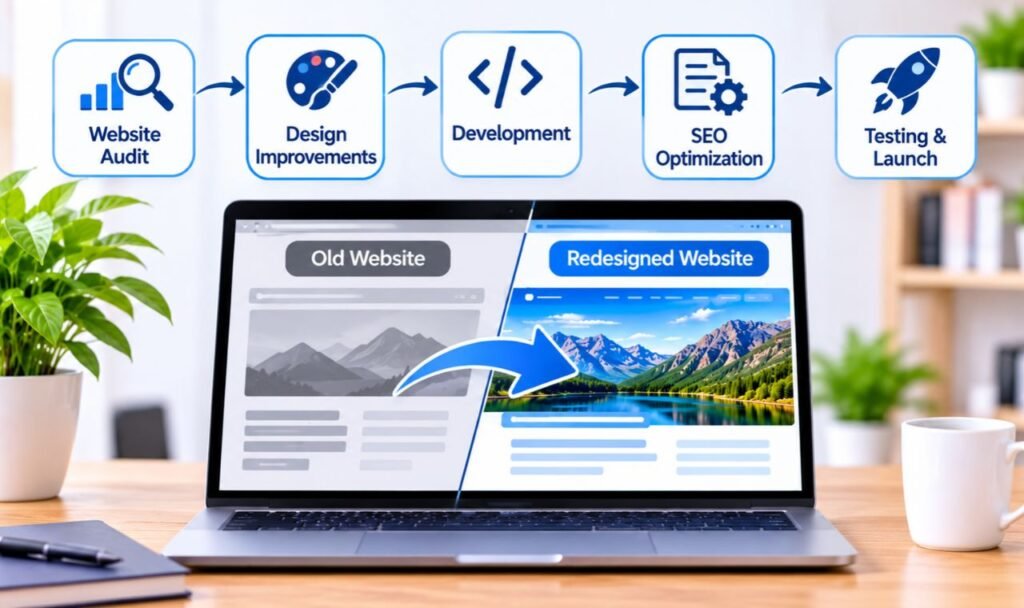
A redesign doesn’t automatically destroy rankings, but careless changes can. Imagine a company that launches a cleaner site with new URLs and no redirects. Old service pages that earned traffic and backlinks now return errors, and Google has to relearn the site from scratch. Even website redesign services with excellent design skills can cause this if SEO is treated as an afterthought.
Google’s guidance on site moves with URL changes covers URL mapping, redirects, sitemap updates, and monitoring. It should shape your plan from the start.
Record organic traffic, top-performing pages, Search Console data, backlinks, indexed URLs, and conversions. This baseline shows what to protect and lets you measure the result later. Without it, you can’t tell whether a drop after launch is normal turbulence or a real problem.
Pages that already attract relevant traffic, backlinks, or enquiries shouldn’t be removed without a good reason. If a URL ranks and the content still serves visitors, keep both and improve them rather than replacing them. A tidier URL structure is rarely worth the risk on a page that already performs.
When a page must move, map each old URL to the most relevant new one and use a permanent 301 redirect. Sending every old URL to the homepage is a common mistake. It discards relevance, frustrates visitors, and gives search engines little reason to carry a page’s value over. Keep a redirect spreadsheet and test it before launch.
Page titles, meta descriptions, headings, canonical tags, and structured data often carry hard-won relevance. Carry them over and refine them instead of resetting them to defaults. Rebuild internal links too, so important pages stay easy for visitors and crawlers to reach.
Compress images, remove unnecessary scripts, and keep layouts responsive. The Core Web Vitals thresholds from web.dev measure loading speed, responsiveness, and visual stability, so use them as targets. A beautiful design that loads slowly can undo the gains you were after.
Use a staging site to check broken links, forms, navigation, and redirects. Confirm robots directives and indexing settings, since a leftover “noindex” instruction from staging can keep the new site out of search results. Generate a fresh XML sitemap, so search engines find the new structure quickly.
Watch Search Console for clicks, impressions, indexing and crawl errors, and track rankings, leads and conversions against your baseline. Temporary fluctuations can happen after major site changes, and no agency can honestly promise uninterrupted rankings. What you can control is how well the migration is planned and how quickly problems get fixed.
Use this as a working site redesign seo checklist and share it with whoever builds your site.
Look beyond attractive screenshots. Good website redesign services come with clear answers to the following:
Questions worth asking before you sign:
SK Web Designing Solutions is a digital agency offering website design and development, SEO, website maintenance, social media marketing, e-commerce store development, and other digital services. Its approach is collaborative, working with clients from the first consultation through to delivery. The process starts by planning the website foundation, then building the site to your requirements, then testing on different devices and browsers before launch.
Having design, development, and digital marketing under one roof can help businesses that want a stronger online presence without coordinating several vendors. Everything above describes general industry practice, and the scope of any project is agreed with the agency directly. If you’d like to talk through your website requirements, you’re welcome to request a consultation.
Website redesign services work best when they start with a clear scope, real business goals, and a plan to protect existing search visibility. Design matters, but so do redirects, content, speed, and testing. Before you commit to a refresh or a full rebuild, audit what your current site does well and where it fails visitors. If you’d like a second opinion, SK Web Designing Solutions is happy to talk through your website requirements and help you decide on the right next step.
It depends on the number of pages and templates, the platform, e-commerce features, integrations, content work, and SEO needs. Quotes vary between providers, so ask for itemized deliverables before comparing prices.
It can if URLs, content, metadata, or internal links change without a plan. Proper redirects, testing, and monitoring reduce the risk, but nobody can guarantee unchanged rankings, and short-term fluctuations are possible.
Timelines depend on site size, the number of templates, content readiness, and how quickly feedback comes back. A refresh usually takes less time than a full rebuild, so ask for milestones in writing.
At minimum: record existing URLs, review traffic, test mobile layouts and forms, verify redirects, check metadata and canonical tags, confirm indexing settings, submit the sitemap, and monitor Search Console.
Yes. Its website lists website design and website development alongside SEO, e-commerce store development, social media marketing, app development, and graphic design. Contact the team to confirm what suits your project.


This article is written by the team at SKWebDesigningSolutions, a Florida-based marketing agency founded in 2016, specializing in web development, branding, SEO, and PR, helping businesses in Orlando and beyond launch, grow, and succeed online. Read More...
